Did Trump Say He Would Cheat to Win Again
Liberal pundits often say that Donald Trump is on the wrong side of history. From this perspective, he's a relic and a reactionary, a living reminder of all the skeletons in America's cupboard.
A Autonomous victory in November thus feels inevitable, especially given Trump's considerately awful treatment of the pandemic.
Simply history but moves the way it is pushed. And from a longue durée view, it's Trump who has the power to exercise the pushing, thanks not only to his deep pockets and ruthlessness simply likewise to the deep back up of ii long-privileged groups in American life.
A white nation
In 1841, Congressmen briefly argued about whether Irish gaelic and German immigrants should be able to claim western lands at the low and regulated prices paid by U.S. citizens. They voted yes, 30-12. As an afterthought, they banned Black Americans from this policy by the count of 37-1.
Nothing meliorate captures the racial terms and conditions of American nationhood every bit it took form in the early 1800s. For white people, America was a land of republican liberty and equality, a behemothic breath of fresh air from the suffocating hierarchies of Europe.
Information technology was besides a violently racist guild that saw Blackness people every bit chattels or nuisances and left no room for Indigenous nations.
Every bit the historian Edmund S. Morgan famously explained, white republicanism and racism grew together. White Americans could be off-white and friendly with each other precisely because they were all members of a privileged group.
Georgia'southward governor put information technology this way as his state seceded from the Wedlock in 1861: Under slavery, even the poorest farmer "belongs to the only true aristocracy, the race of white men."
The Ceremonious War destroyed slavery just preserved white supremacy. The U.s. remained a haven for many millions of Europeans, while Blackness people did not even proceeds de jure citizenship until the 1960s.
An employers' republic
Racism aside, the virtually hit thing about the 1841 vote on western lands was its assumption that all white men deserved to own holding. Most Americans embraced this platonic because it spread power widely through society, enabling every white man to exist his ain dominate.
The dream was existent enough until the late 1800s, when family farming collapsed and huge new corporations took over much of the economic system. The percentage of men who were self-employed plummeted through the early 1900s, stoking bitter class struggles that only calmed with the post-2nd World War boom.
For much of the Cold State of war, prosperity kept employees happy even as real power rested with their employers — the people who decided whom to rent and fire.
In Canada and most European countries in this period, left-leaning parties won major public interventions in health care and labour relations, curbing the power of employers and giving most people social and economic rights that come from their citizenship, not their work.
That never happened in the Us.
Most Americans thus need their employers non only for wages or salaries, but also for health insurance. America'southward weak safety net makes workers even more fearful of losing their jobs.
Fifty-fifty though they make up a tiny fraction of the population, bosses thus wield enormous clout over everyday life. In America more than in other western countries, their detail interests tend to stand in for "common sense."
Making America comfortable again
What does this have to do with Trump's re-election chances?
First, nosotros need to recall that many white Americans have felt on the defensive since the Civil Rights revolution of the 1960s. They don't see themselves as racist, even so they're too uncomfortable sharing ability and visibility with people of colour.
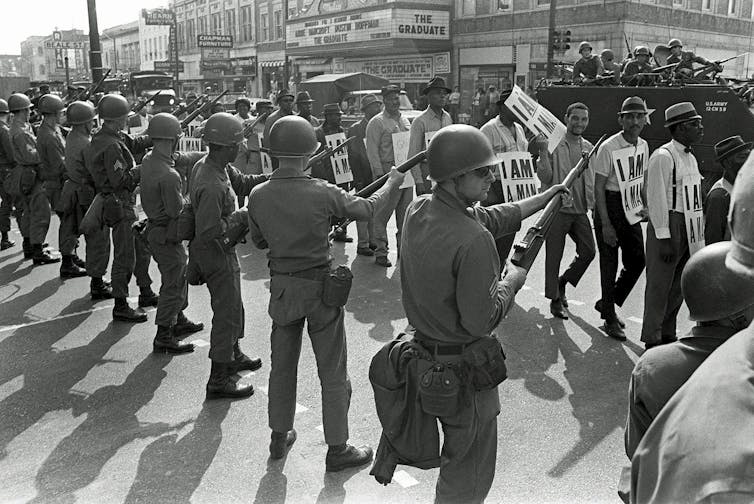
In effect, Trump invites such voters to be comfortable once again with their white privileges. This certainly worked in 2016. "From the beer runway to the vino track, from soccer moms to NASCAR dads," Ta-Nehesi Coates wrote in The Atlantic in 2017, "Trump'south performance among whites was dominant." Amid white women, he bested Hilary Clinton by nine points; amidst white men, he prevailed past 31 points.
As for the nation's employers, the concluding 50 years accept been kind: all Republicans and many Democrats have rolled back the express gains that labour fabricated during the New Bargain.
For corporate titans likewise as pocket-sized business owners, Trump is more good news. As early as 2000, Trump announced his desire to privatize (that is, to end) Social Security. In office, he's slashed taxes on businesses and the wealthy along with health, safe and environmental regulations.
Trump even throws a few basic to manufacturing companies by raising tariffs on friends and foes alike.
For all his volatility and incompetence, then, Trump is the default choice — fifty-fifty the safe pick — for a critical mass of white voters and business organisation owners. The deaths of well-nigh 170,000 Americans to COVID-19 won't change that, in part considering the victims are disproportionately Black, Indigenous, people of colour and poorer workers.
With all this history on his side, Trump will be hard to beat even if he fights off-white, which he almost certainly will not exercise.
The Democrats are in for a drastic fight.
Source: https://theconversation.com/trump-could-win-again-without-cheating-144539

Postar um comentário for "Did Trump Say He Would Cheat to Win Again"