Is Communication More of an Art Than a Science
It's a challenging time to be a science communicator. The electric current pandemic, climate crisis, and concerns over new technologies from artificial intelligence to genetic modification by CRISPR need public accountability, clear discussion and the ability to disagree in public.
However, science advice is non new to claiming. The 20th century can exist read as a long argument for scientific discipline communication in the interest of the public good.
Since the 2d Earth State of war, there have been many efforts to negotiate a social contract between scientific discipline and civil gild. In the West, part of that negotiation has emphasised the distribution of scientific knowledge. But how is the relationship between science and lodge formulated around the globe?
We collected stories from 39 countries together into a volume, Communicating Science: A Global Perspective, to sympathise how science communication has unfolded internationally. Globally it has played a central office in public wellness, environmental protection and agriculture.
Three key ideas emerge: community noesis is a powerful context; successful scientific discipline advice is integrated with other beliefs; and there is an expectation that researchers volition contribute to the development of order.
Baca juga: Three central drivers of good messaging in a time of crisis: expertise, empathy and timing
What is science communication?
The term "science communication" is not universal. For 50 years, what is called "scientific discipline communication" in Commonwealth of australia has had different names in other countries: "scientific discipline popularisation", "public understanding", "vulgarisation", "public understanding of science", and the tillage of a "scientific temper".
Republic of colombia uses the term "the social cribbing of science and engineering science". This definition underscores that scientific knowledge is transformed through social interaction.
Each definition delivers insights into how scientific discipline and society are positioned. Is science imagined equally part of club? Is science held in high esteem? Does association with social issues lessen or strengthen the perception of scientific discipline?
Baca juga: Engaging the disengaged with science
Governments play a variety of roles in the stories we nerveless. The 1970s German government stood back, mayhap recalling the unsavoury relationship between Nazi propaganda and scientific discipline. Individual foundations filled the gap by funding ambitious programs to train scientific discipline journalists. In the Usa, the absence of a strong central agency encouraged diversity in a field described variously as "vibrant", "jostling" or "cacophonous".
The United Kingdom is the opposite, providing one of the all-time-documented stories in this field. This is exemplified by the Purple Lodge's Bodmer Study in 1985, which argued that scientists should consider it their duty to communicate their piece of work to their young man citizens.
Russian federation saw a country-driven focus on scientific discipline through the communist years, to modernise and industrialise. In 1990 the Cognition Club'south weekly science newspaper Argumenty i Fakty had the highest weekly circulation of whatsoever newspaper in the world: 33.5 million copies. Merely the collapse of the Soviet Union showed how frail these scientific views were, as people turned to mysticism.

Many national accounts refer to the human relationship between indigenous knowledge and Western scientific discipline. Aotearoa New Zealand is managing this well (there'south a inkling in the proper noun), with its focus on mātauranga (Māori knowledge). The integration has not always been polish sailing, but Māori views are now incorporated into nationwide science funding, enquiry practice and public engagement.
Ecologist John Perrott points out that Māori "belonging" (I belong, therefore I am) is at odds with Western scientific preparation (I retrieve, therefore I am). In Māori whakapapa (genealogy and cosmology), relationships with the land, flora and fauna are fundamental and all life is valued, every bit are collaboration and nurturing.
Science communication in the Global S
Eighteen countries contributing to the book have a recent colonial history, and many are from the Global South. They saw the end of colonial rule as an opportunity to embrace science. As Republic of ghana'south Kwame Nkrumah said in 1963 to a coming together of the Organisation of African Unity:
Nosotros shall bleed marshes and swamps, clear infested areas, feed the under-nourished, and rid our people of parasites and disease. It is within the possibility of science and technology to make even the Sahara bloom into a vast field with verdant vegetation for agricultural and industrial developments.
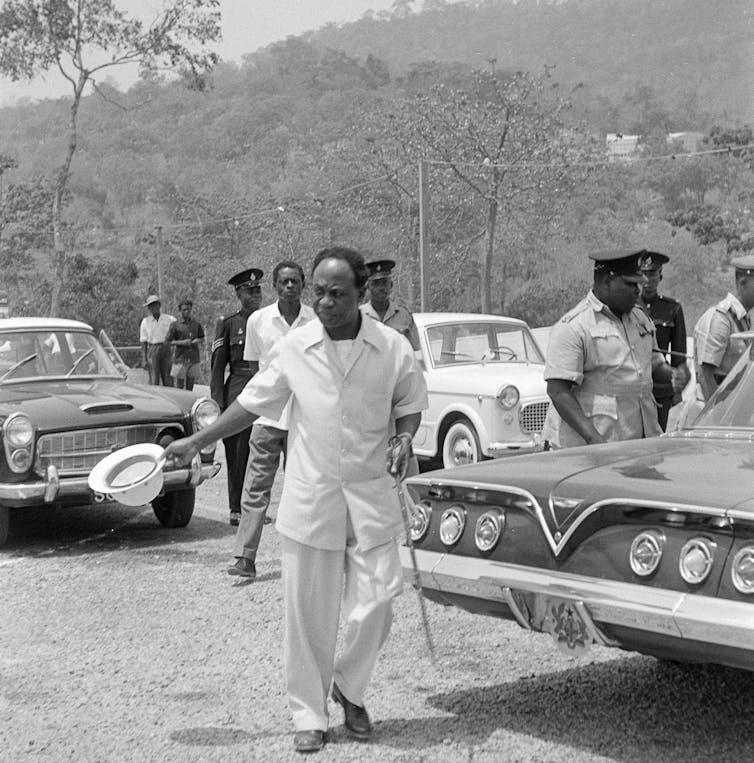
Plans were formulated and optimism was potent. A lot depended on science advice: how would science be introduced to national narratives, gain political impetus and influence an education system for science?
Science in these countries focused mainly on health, the surroundings and agriculture. Nigeria'due south polio vaccine campaign was almost derailed in 2003 when ii influential groups, the Supreme Quango for Shari'ah in Nigeria and the Kaduna State Council of Imams and Ulamas, declared the vaccine contained anti-fertility substances and was part of a Western conspiracy to sterilise children. Simply after five Muslim leaders witnessed a successful vaccine program in Egypt was information technology recognised as being uniform with the Qur'an.
Three key ideas
Three principles sally from these stories. The offset is that community knowledge is a powerful force. In rural Kenya, the number of babies delivered past unskilled people led to high mortality. Local science communication practices provided a solution. A baraza (community discussion) integrated the health trouble with social solutions, and trained local motorcycle riders to transport mothers to hospitals. The baraza used role-plays to depict the arrival of a mother to a wellness facility, reactions from the wellness providers, eventual safe delivery of the babe, and mother and baby riding back home.
A second principle is how science communication can enhance the integration of science with other beliefs. Science and organized religion, for example, are not e'er at odds. The Malaysian chapter describes how Muslim concepts of halal (permitted) and haram (forbidden) make up one's mind the acceptability of biotechnology co-ordinate to the principles of Islamic law. Does science pose any threat to the five purposes of maslahah (public interest): religion, life and health, progeny, intellect and property? It is not hard to see the resemblance to Western ethical considerations of controversial science.
Baca juga: What scientific discipline communicators tin can learn from listening to people
The third is an arroyo to pursuing and debating science for the public skilful. Science communication has made science more accessible, and public opinions and responses more probable to exist sought. The "3rd mission", an established principle across Europe, is an expectation or obligation that researchers will contribute to the growth, welfare and development of society. Universities are expected to exchange knowledge and skills with others in society, disseminating scientific results and methods, and encouraging public argue.
These lessons near science communication will exist needed in a post-COVID world. They are finding an audience: we have fabricated the book freely bachelor online, and it has so far been downloaded more than than xiv,000 times.
Source: https://theconversation.com/science-communication-is-more-important-than-ever-here-are-3-lessons-from-around-the-world-on-what-makes-it-work-147670

Postar um comentário for "Is Communication More of an Art Than a Science"